EXW: Understanding Ex Works
Published on: September 26, 2026
Where delivery takes place under EXW, who arranges collection and transport, and what the quoted price usually covers.
Based on normal Incoterms® 2020 arrangements
EXW stands for Ex Works. It can be used with any mode of transport, and delivery may take place at a factory, warehouse or another agreed location.
Under EXW, the seller’s main task is to make the goods available for collection as agreed. The seller is generally not responsible for loading them onto the collecting vehicle or clearing them for export. The buyer organises most of the transport from the collection point to the final destination.
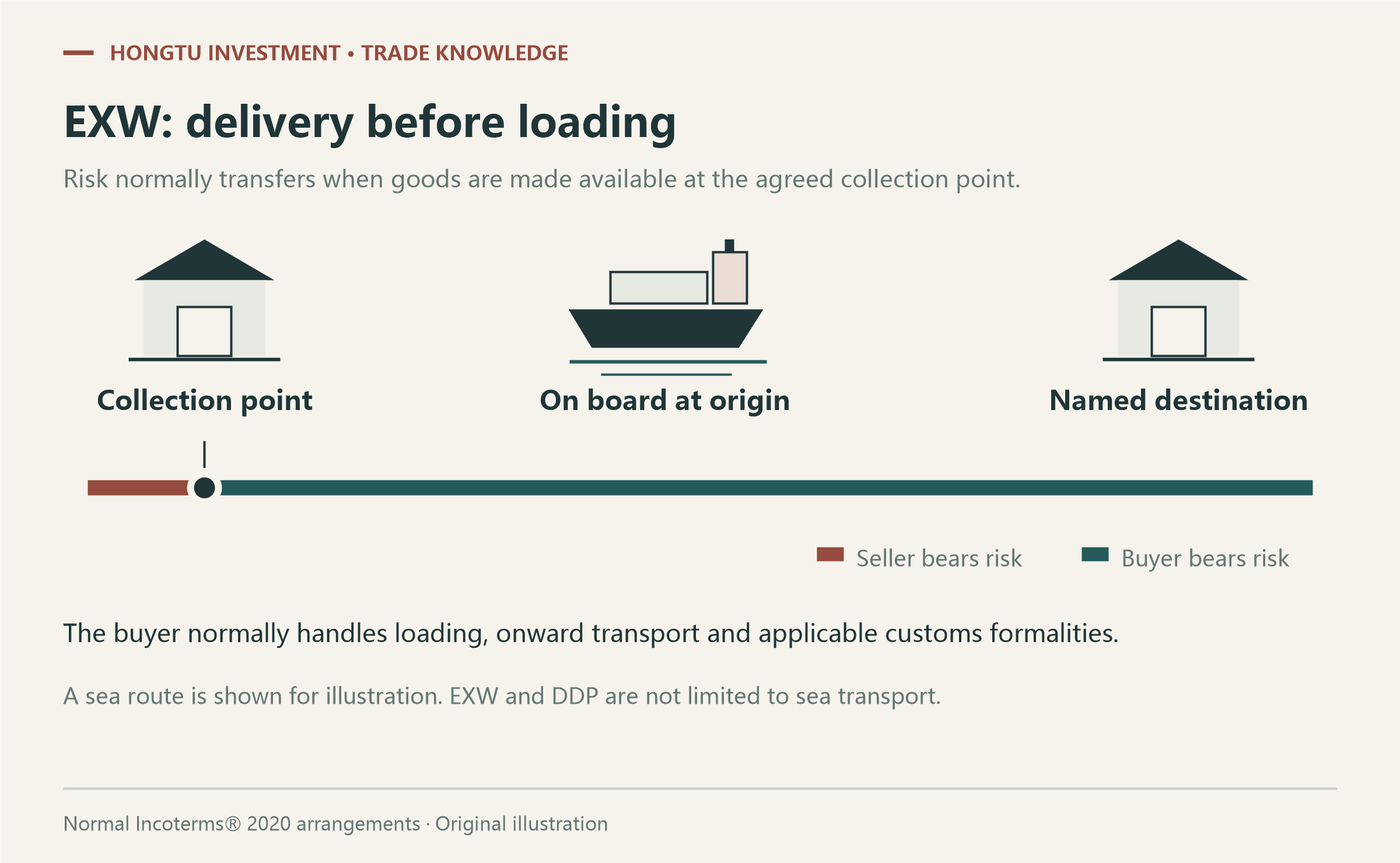
EXW risk normally passes when goods are made available at the agreed collection point, before loading.
This division of responsibilities determines what an EXW price covers. Loading at collection, onward transport and export and import clearance are generally excluded, so the buyer bears these expenses in addition to the price of the goods. A lower EXW unit price may simply reflect fewer included services; it does not necessarily mean a lower total procurement cost.
Another feature of EXW is the early transfer of cargo risk. Risk normally passes when the goods have been made available to the buyer at the agreed time and place, without waiting for them to be loaded or to leave the factory. This explains why collection and loading fall largely within the buyer’s responsibilities.
EXW gives buyers with established transport arrangements considerable scope to organise collection and onward logistics. A buyer might, for example, consolidate goods from several suppliers into a single shipment. In cross-border trade, however, the buyer also handles export formalities. Its ability to complete those formalities in the country of dispatch can be a practical constraint.
EXW is often understood simply as a factory price, but it describes more than a price basis. It also establishes where goods are delivered, who arranges onward transport and when risk passes to the buyer.
References